How to create a custom callback in Keras
Model training often needs project-specific logging or state capture without moving that behavior into a layer or loss function. A Keras callback receives lifecycle events from fit(), which keeps those side effects separate from the model definition.
Custom callbacks subclass keras.callbacks.Callback and override only the lifecycle methods they need. on_epoch_end() receives a zero-based epoch index and a logs dictionary containing the loss and compiled metrics for that epoch.
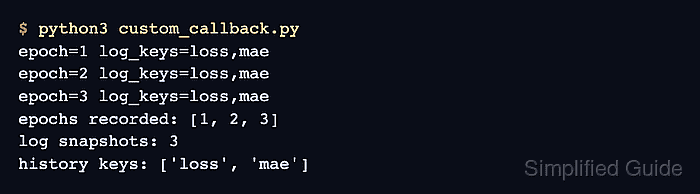
A small regression model is enough to exercise the callback without downloading a dataset. The retained epoch list and metric-key snapshots prove that the callback ran after every requested epoch and kept the observed training state.
Related: How to use EarlyStopping in Keras
Related: How to use ModelCheckpoint in Keras
Related: How to create a custom train step in Keras
Steps to create a custom Keras callback:
- Create custom_callback.py with the imports and the EpochLogRecorder callback class.
- custom_callback.py
import keras
import numpy as np


class EpochLogRecorder(keras.callbacks.Callback):
    def __init__(self):
        super().__init__()
        self.epochs = []
        self.log_keys = []

    def on_train_begin(self, logs=None):
        self.epochs.clear()
        self.log_keys.clear()

    def on_epoch_end(self, epoch, logs=None):
        keys = sorted((logs or {}).keys())
        self.epochs.append(epoch + 1)
        self.log_keys.append(keys)
        print(f"epoch={epoch + 1} log_keys={','.join(keys)}")
on_train_begin() resets callback-owned state for each fit() call, while on_epoch_end() records the epoch number and metric names supplied by Keras.
- Append the deterministic training data and compiled regression model below the callback class.
keras.utils.set_random_seed(7)

x_train = np.arange(0, 8, dtype="float32").reshape(-1, 1)
y_train = (2 * x_train) + 1

model = keras.Sequential(
    [
        keras.layers.Input(shape=(1,)),
        keras.layers.Dense(1),
    ]
)
model.compile(
    optimizer=keras.optimizers.SGD(learning_rate=0.05),
    loss="mse",
    metrics=["mae"],
)
- Append the callback instance and fit() call below the model configuration.
recorder = EpochLogRecorder()
history = model.fit(
    x_train,
    y_train,
    batch_size=4,
    epochs=3,
    verbose=0,
    callbacks=[recorder],
)
The callbacks list registers each object for the lifecycle points implemented by its class.
- Append the retained-state checks below the fit() call.
assert recorder.epochs == [1, 2, 3]
assert recorder.log_keys == [["loss", "mae"]] * 3

print("recorded epochs:", recorder.epochs)
print("recorded log keys:", recorder.log_keys)
print("history keys:", sorted(history.history.keys()))
- Run custom_callback.py to exercise the callback during three training epochs.
$ python3 custom_callback.py
epoch=1 log_keys=loss,mae
epoch=2 log_keys=loss,mae
epoch=3 log_keys=loss,mae
recorded epochs: [1, 2, 3]
recorded log keys: [['loss', 'mae'], ['loss', 'mae'], ['loss', 'mae']]
history keys: ['loss', 'mae']
One callback line per epoch plus the retained lists confirm that fit() invoked on_epoch_end() three times with both compiled training quantities.