How to query DNS over HTTPS with dig
An encrypted resolver test should prove more than whether a domain returns an address. dig can send one DNS question through DNS over HTTPS (DoH), so an operator can exercise a specific HTTPS endpoint without changing the computer's system resolver.
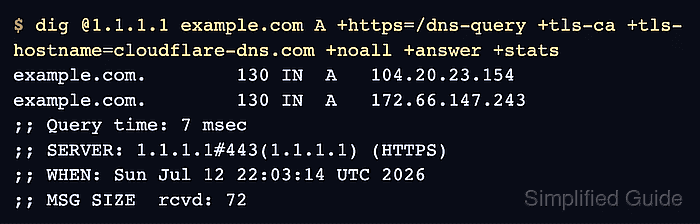
Current BIND releases use +https for an HTTP POST request on port 443. Supplying +tls-ca enables certificate-authority validation, while +tls-hostname provides the expected certificate identity when the resolver is addressed by IP.
This test sends only the named query to Cloudflare's public resolver; it does not route other applications through DoH. The resolver can still read the DNS question, and returned addresses, order, TTL, and query time can differ from the sample output.
Related: How to query DNS over TLS with dig
Tool: DoH Query Packet Crafter
Steps to query DNS over HTTPS with dig:
- Test the DoH endpoint with a deliberately mismatched TLS identity.
$ dig @1.1.1.1 example.com A +https=/dns-query +tls-ca +tls-hostname=example.net +time=3 +tries=1
;; communications error to 1.1.1.1#443: failure

; <<>> DiG 9.20.18-1ubuntu2.1-Ubuntu <<>> @1.1.1.1 example.com A +https=/dns-query +tls-ca +tls-hostname=example.net +time=3 +tries=1
; (1 server found)
;; global options: +cmd
;; no servers could be reached
The failed connection is expected because Cloudflare's certificate does not identify example.net. Disabling +tls-ca would remove this identity check.
- Send the A-record query to Cloudflare's DoH endpoint with its expected TLS identity.
$ dig @1.1.1.1 example.com A +https=/dns-query +tls-ca +tls-hostname=cloudflare-dns.com +noall +answer +stats
example.com.        130 IN  A   104.20.23.154
example.com.        130 IN  A   172.66.147.243
;; Query time: 7 msec
;; SERVER: 1.1.1.1#443(1.1.1.1) (HTTPS)
;; WHEN: Sun Jul 12 22:03:14 UTC 2026
;; MSG SIZE  rcvd: 72
The answer records prove that the DNS question completed, while the SERVER line identifies 1.1.1.1 on HTTPS port 443. Other query names and record types use the same transport options.